
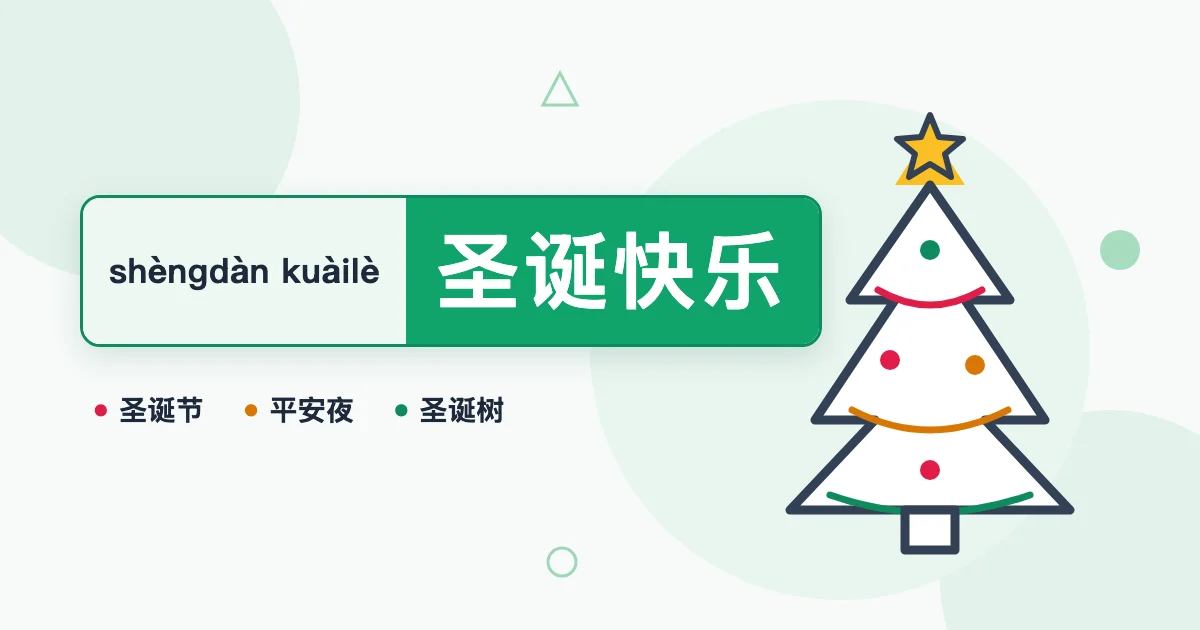
Quick answer: Merry Christmas in Chinese is 圣诞快乐 (shèngdàn kuàilè). Say it roughly "shung-dahn kwhy-luh": all four syllables use the falling fourth tone. In traditional characters it is 聖誕快樂, and in Cantonese it sounds like sing daan faai lok. To wish someone a merry Christmas and a happy new year, say 圣诞快乐,新年快乐 (shèngdàn kuàilè, xīnnián kuàilè).
Whether you want to message a Chinese friend, write a card to a colleague in Shanghai, or surprise your Mandarin teacher, this guide covers everything you need to say Merry Christmas in Chinese with confidence. You'll learn what each character means, how the tones work, how to write it in simplified and traditional Chinese, how to say it in Cantonese, and more than a dozen ready-to-send Christmas wishes in Chinese, each with pinyin and an English translation.
Learn holiday greetings the way you'll use them
Hear each phrase from a native speaker, then type it in pinyin. Typing forces you to recall the tones, so the words stick.
Try the Chinese Greetings Course →Merry Christmas in Chinese: 圣诞快乐 Character by Character
The standard way to say Merry Christmas in Chinese is four characters long. Two of them name the holiday, and two of them wish happiness:
| Character | Pinyin | Meaning |
|---|---|---|
| 圣 | shèng | holy |
| 诞 | dàn | birth (圣诞 = Christmas) |
| 快 | kuài | pleasant (快乐 = happy) |
| 乐 | lè | joy |
圣诞 (shèngdàn) literally means "holy birth", the birth of Jesus, and it is the word Chinese uses for Christmas. 快乐 (kuàilè) is the everyday word for "happy". You already know it if you have heard 生日快乐 (shēngrì kuàilè, happy birthday) or 新年快乐 (xīnnián kuàilè, happy new year). Chinese greetings follow a simple pattern: occasion + 快乐.
So 圣诞快乐 is, word for word, "Christmas happy", which is exactly how a Chinese speaker says Merry Christmas.
How to Pronounce 圣诞快乐
- 圣 shèng — fourth tone, a sharp fall from high to low. The sh is like English "shoe" with the tongue curled back slightly. The eng sounds like the "ung" in "lung".
- 诞 dàn — fourth tone again. Rhymes with "khan", said with a firm drop.
- 快 kuài — fourth tone. Sounds like "kwhy".
- 乐 lè — fourth tone. Sounds like "luh", short and clipped.
All four syllables are fourth tones, so 圣诞快乐 has a strong, cheerful rhythm: down, down, down, down. Don't let it sound angry. Native speakers soften the second and fourth syllables slightly, so it comes out as SHÈNG-dan KUÀI-le.
Chinese has no separate word for "merry". 快乐 (kuàilè) covers "merry", "happy" and "joyful", so Merry Christmas and Happy Christmas are the same phrase in Chinese: 圣诞快乐.
圣诞快乐 vs 圣诞节快乐: Which Is Correct?
Both are correct, and you will see both on cards, posters and social media.
- 圣诞快乐 (shèngdàn kuàilè) — the short, standard form. This is what most people say out loud.
- 圣诞节快乐 (shèngdànjié kuàilè) — adds 节 (jié), "festival" or "holiday". 圣诞节 is the full name of Christmas Day, so the phrase reads "Happy Christmas holiday". It sounds slightly fuller and is common in written wishes.
Use 圣诞快乐 when speaking and in quick messages. Use either one in a card. If you're greeting someone on Christmas Eve, switch to 平安夜快乐 (píng'ānyè kuàilè), "Happy Christmas Eve".
How to Write Merry Christmas in Chinese: Simplified and Traditional
Mainland China and Singapore use simplified characters. Taiwan, Hong Kong and Macau use traditional characters. Two of the four characters are different:
| Simplified | Traditional | |
|---|---|---|
| Merry Christmas | 圣诞快乐 | 聖誕快樂 |
| Christmas (Day) | 圣诞节 | 聖誕節 |
| Christmas Eve | 平安夜 | 平安夜 |
| Santa Claus | 圣诞老人 | 聖誕老人 |
If your friend is from Taiwan or Hong Kong, write 聖誕快樂. If they are from mainland China, write 圣诞快乐. Everyone can read both, but using their script is a thoughtful touch.
Typing it on a phone or computer: with a pinyin keyboard, type shengdankuaile and choose 圣诞快乐 from the candidates. Most keyboards suggest the whole phrase after the first few letters. You can also try it in our free online Chinese keyboard.
Merry Christmas in Cantonese
In Hong Kong, Macau and many overseas Chinese communities, people speak Cantonese. The characters are the same as the traditional form, 聖誕快樂, but the pronunciation is different:
- 聖誕快樂 — Jyutping: sing3 daan3 faai3 lok6
- Roughly: "sing dahn fie lok"
Cantonese has six tones. The numbers in Jyutping mark them: 3 is a mid level tone and 6 is a low level tone. If you are learning Mandarin, stick with shèngdàn kuàilè. Speakers in Hong Kong will understand it, and many will be delighted you tried.
Merry Christmas and Happy New Year in Chinese
In December, people often send one message that covers both holidays:
Here, 新年 (xīnnián) means the January 1 new year, which in Chinese is also called 元旦 (yuándàn). The big Chinese holiday comes later: Chinese New Year, or Spring Festival (春节 chūnjié), falls on February 6 in 2027 and starts the Year of the Goat. For that holiday people use greetings such as 新年快乐, 春节快乐 (chūnjié kuàilè) and 恭喜发财 (gōngxǐ fācái).
Getting ready for Chinese New Year too?
Learn the words for red envelopes, fireworks and reunion dinners, with native audio and pinyin typing practice.
Explore the Chinese New Year Course →Christmas Wishes in Chinese for Cards and Messages
Saying Merry Christmas in Chinese is a great start. Adding a short wish makes your message personal. Tap the speaker on any card to hear it. The word 祝 (zhù), "to wish", turns any phrase into a blessing: 祝你 + wish.
Short Wishes for Friends
Doubling words, as in 平平安安 and 快快乐乐, is a warm, playful way to stress a wish. It is very common in holiday messages.
Wishes for Family and Elders
Use the polite 您 (nín) instead of 你 (nǐ) for parents-in-law, teachers and older relatives:
Wishes for Colleagues and Clients
Chinese cards usually start with the person's name and a colon, then the wish, then your name at the bottom right. For example: 王老师:祝您圣诞快乐,新年快乐!— 小明. ("Teacher Wang: Merry Christmas and Happy New Year! — Xiaoming")
Christmas Vocabulary in Chinese
Once you can say Merry Christmas in Chinese, these words let you talk about the rest of the holiday:
Notice how many words reuse 圣诞 (shèngdàn): Christmas tree is "Christmas tree" (圣诞树) and Santa is "Christmas old man" (圣诞老人). Learning one word unlocks a whole family of words. This is one of the nicest things about Chinese vocabulary.
A few example sentences:
"We Wish You a Merry Christmas" in Chinese
The classic carol has a well-known Chinese version that children learn at school:
It means exactly what the English means: "We wish you a merry Christmas … and a happy new year!" Singing it is a fun way to practice the tones of 圣诞快乐, because the melody makes you repeat the phrase over and over.
Two other carols with famous Chinese titles:
- Jingle Bells — 铃儿响叮当 (Líng'ér xiǎng dīngdāng), "the bells ring ding-dong"
- Silent Night — 平安夜 (Píng'ānyè), the same word as "Christmas Eve"
How Christmas Is Celebrated in China
Christmas is not a public holiday in mainland China, and most people do not celebrate it as a religious festival. Even so, it has become a popular season, especially in big cities:
- Shopping and decorations. Malls put up giant Christmas trees and run holiday sales from early December.
- A night out with friends. Many young people treat Christmas Eve like a fun night out, or a romantic one, similar to Valentine's Day.
- Peace apples. On Christmas Eve, friends give each other apples wrapped in colorful paper. The tradition is a pun: Christmas Eve is 平安夜 (píng'ānyè, "peaceful night") and apple is 苹果 (píngguǒ). Both start with píng, so an apple wishes the receiver a peaceful year.
In Hong Kong, Christmas Day and the first weekday after it are public holidays. In Macau, Christmas Eve and Christmas Day are public holidays. In Taiwan, December 25 is also Constitution Day, but it is no longer a day off.
For most people in mainland China, Christmas means lights, gifts and get-togethers rather than church. That is why you'll hear 圣诞快乐 in shops and offices across China, even from people who don't celebrate Christmas at home.
Common Mistakes When Saying Merry Christmas in Chinese
- Flattening the tones. All four syllables of 圣诞快乐 fall. Saying shēng dān with a flat first tone sounds like a different word to a native speaker.
- Mixing up 乐 lè and 了 le. In 快乐, 乐 is a full fourth tone (lè), not the light grammar particle 了 (le). Keep it short but clear.
- Writing 圣旦 instead of 圣诞. 旦 (dàn) means "dawn" and is used in 元旦 (New Year's Day). Christmas needs 诞 (dàn), "birth", with the speech radical 讠 on the left.
- Leaving 新年 ambiguous. In a December message, 新年快乐 means "Happy New Year" for January 1. Around the Lunar New Year it means the Spring Festival. If you want to be clear, say 元旦快乐 (yuándàn kuàilè) for January 1 or 春节快乐 (chūnjié kuàilè) for Chinese New Year.
How to Practice Merry Christmas in Chinese
Holiday phrases are easy to learn because you can use them right away. Try this:
- Listen first. Play a native recording of 圣诞快乐 and copy the four falling tones.
- Type it from memory. Type
shengdankuaileand pick the right characters. When you have to produce the pinyin yourself, you remember it much better than when you only read it. - Send it. Message one Chinese-speaking friend, teacher or colleague on December 24 or 25. Real use is the best memory aid.
- Learn the neighbors. Greetings come in families. Once you know 圣诞快乐, you are one step from 生日快乐 (happy birthday) and 新年快乐 (happy new year). Our guides to hello in Chinese and goodbye in Chinese cover the everyday basics.
Say 圣诞快乐 — and Much More — With Confidence
Our Say It Right: Chinese Greetings course teaches the greetings you'll use every day and on every holiday, with native audio and interactive pinyin typing. Learn Chinese one real phrase at a time.
Start the Greetings Course — Free
References
- Christmas in China — Wikipedia
- General holidays in Hong Kong — GovHK
- 圣诞 (shèngdàn) — MDBG Chinese Dictionary
- Jyutping — Wikipedia
- Standard Chinese phonology — Wikipedia
Want to keep going? Explore our full course library and learn Mandarin through the phrases you'll actually use.


