
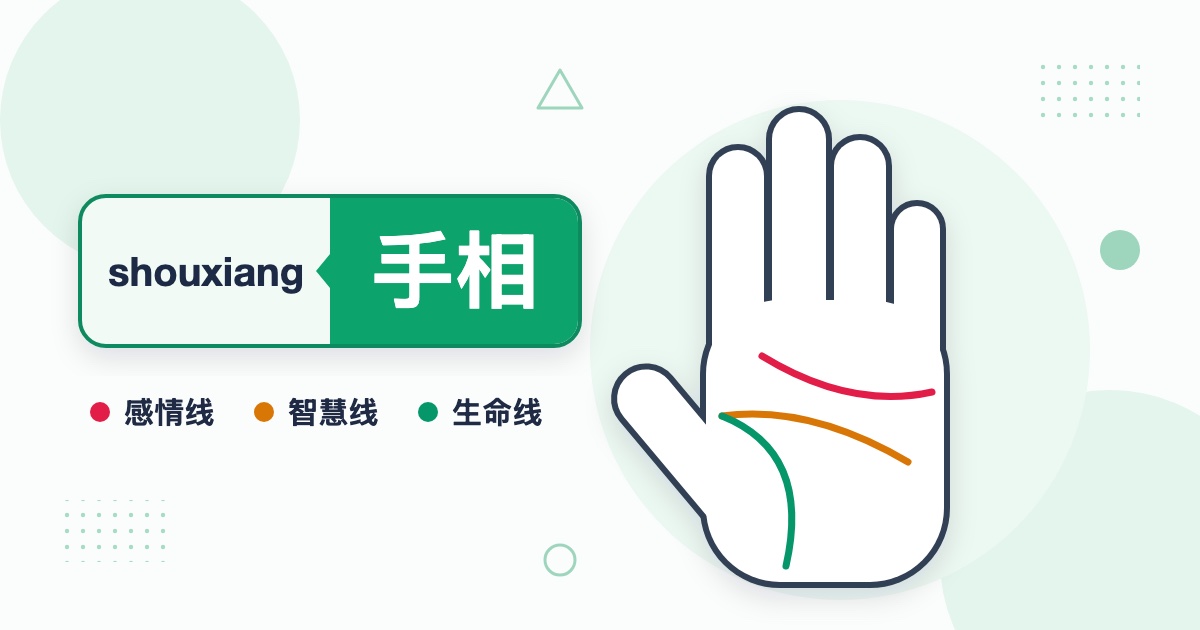
Chinese palmistry (手相, shǒuxiàng) is the Chinese art of reading character and fortune from the hand. It is one of the oldest branches of Chinese fortune telling, and it is still part of daily life: grandparents compare palm lines at the dinner table, friends read each other's hands for fun, and street fortune tellers set up near temples before Chinese New Year. This guide explains how Chinese palm reading works, what each line means, and the Mandarin words you need to talk about it.
Quick answer: In Chinese palmistry the three main lines are the life line (生命线), the head line (智慧线) and the heart line (感情线). Tradition says men read the left hand and women the right (男左女右). The reader also looks at the fate line, the marriage line, the shape of the hand and the zones of the palm.
What Is Chinese Palmistry? (手相 shǒuxiàng)
The word 手相 joins 手 (shǒu, hand) and 相 (xiàng, appearance). The same 相 appears in 面相 (miànxiàng, face reading), and both belong to a wider practice called 相术 (xiàngshù), the art of reading a person's nature from how they look. Palmistry is not only Chinese. India has its own very old tradition, and Western palmistry grew from Greek and later European sources. The Chinese branch developed its own vocabulary and its own way of mapping the palm.
Chinese tradition dates hand reading to the Zhou dynasty, more than two thousand years ago. The philosopher Wang Chong (王充) discussed reading the body in his first-century book Lunheng (论衡). The best-known manual is the Mayi Shenxiang (麻衣神相), a face and hand reading text attributed to a Song dynasty Daoist. Fortune tellers still quote it today.
Key vocabulary:
- 手相 (shǒuxiàng) — palmistry; the features of one's palm; "Can you read palms?" (你会看手相吗?)
- 看手相 (kàn shǒuxiàng) — to read a palm; to have one's palm read; "She read my palm." (她给我看了手相。)
- 算命 (suànmìng) — fortune telling; "Do you believe in fortune telling?" (你相信算命吗?)
- 命运 (mìngyùn) — fate; destiny; "Fate is in your own hands." (命运掌握在自己手中。)
- 面相 (miànxiàng) — face reading; "Face reading and palm reading often go together." (面相和手相常常一起看。)
手相 means both the practice and the thing being read. 我的手相很好 means "my palm (reading) is good", much as English uses "handwriting" for both the act and the result. The verb is almost always 看 (kàn, to look): in Chinese you "look at" a palm, you don't "read" it.
The Three Main Lines of Chinese Palm Reading
Every palm has three deep lines, and Chinese palmistry starts with them. Modern Mandarin uses plain names: life line, wisdom line, feeling line. Classical texts use an older set of names taken from 三才 (sāncái), the "three powers" of Heaven, Earth and Humanity.
| Line | Modern name | Pinyin | Classical name | Traditionally shows |
|---|---|---|---|---|
| Life line | 生命线 | shēngmìng xiàn | 地纹 (dì wén), Earth line | Vitality, health, stamina |
| Head line | 智慧线 | zhìhuì xiàn | 人纹 (rén wén), Human line | Thinking style, talent, focus |
| Heart line | 感情线 | gǎnqíng xiàn | 天纹 (tiān wén), Heaven line | Emotions, love, relationships |
Life line: 生命线
The life line curves around the base of the thumb. A common belief is that a short life line means a short life. Chinese readers reject this: the line is read for energy and health, not for a number of years. A deep, clear, wide curve suggests strong vitality. A faint or broken line suggests a period of low energy or change.
Head line: 智慧线
The head line runs across the middle of the palm. The Chinese name means "wisdom line". A long, straight line is read as practical and logical thinking. A line that slopes down toward the wrist is read as imagination and creativity.
Heart line: 感情线
The heart line is the top line, running under the fingers. A line that ends between the index and middle fingers is read as warm and balanced in love. A very straight line suggests someone who keeps their feelings under control.
Key vocabulary:
- 掌纹 (zhǎngwén) — palm lines; "Everyone's palm lines are different." (每个人的掌纹都不一样。)
- 线 (xiàn) — line; thread; "This line is very long." (这条线很长。)
- 生命线 (shēngmìng xiàn) — life line; "Your life line is long and deep." (你的生命线又长又深。)
- 智慧线 (zhìhuì xiàn) — head line; "His head line is very straight." (他的智慧线很直。)
- 感情线 (gǎnqíng xiàn) — heart line; "What does my heart line say?" (我的感情线说明什么?)
Want to see these lines marked on your own hand? Try an AI palm reading from a single photo: PalmReading.pro finds your life, head, heart and fate lines and explains each one, using a method that draws on Chinese, Indian and Western palmistry. The preview is free and needs no sign-up.
Other Lines: Career, Marriage and Money
After the three main lines, a Chinese reader looks for the smaller ones. Not everyone has all of them, and that in itself is part of the reading.
| Line | Chinese | Pinyin | Where it is | Traditionally shows |
|---|---|---|---|---|
| Fate / career line | 事业线 | shìyè xiàn | Runs up the center of the palm toward the middle finger | Career path, direction in life |
| Marriage line | 婚姻线 | hūnyīn xiàn | Short lines on the edge of the palm below the little finger | Serious relationships, marriage |
| Money line | 财运线 | cáiyùn xiàn | Below the ring and little fingers | Luck with money |
| Sun line | 太阳线 | tàiyáng xiàn | Runs up toward the ring finger | Reputation, success, popularity |
The fate line has other names too. 命运线 (mìngyùn xiàn, "destiny line") is common, and old texts call it 玉柱纹 (yùzhù wén), the "jade pillar line", because a strong one stands straight up the palm like a column.
Which Hand to Read: 男左女右
The classic rule is 男左女右 (nán zuǒ nǚ yòu): "men left, women right". A fortune teller following tradition reads a man's left hand and a woman's right. The rule comes from yin and yang thinking, where left is linked with yang and right with yin. You will meet the same phrase outside palmistry, for example in where a couple stands in a traditional wedding photo.
Many readers today use a different system and look at both hands:
- The left hand shows what you were born with: 先天 (xiāntiān, innate).
- The right hand shows what you have made of it: 后天 (hòutiān, acquired).
Key vocabulary:
- 左手 (zuǒshǒu) — left hand; "Give me your left hand." (把左手给我。)
- 右手 (yòushǒu) — right hand; "I write with my right hand." (我用右手写字。)
- 先天 (xiāntiān) — innate; inborn; "Talent is partly innate." (天赋有一部分是先天的。)
- 后天 (hòutiān) — acquired; learned after birth; "Effort after birth matters more." (后天的努力更重要。)
后天 also means "the day after tomorrow". Context makes it clear: 后天见 is "see you the day after tomorrow", while 后天的努力 is "effort made after birth".
The Five Element Hand Shapes (五行手形)
Western palmistry sorts hands into four elements. Chinese palm reading uses the Five Elements (五行, wǔxíng): Metal, Wood, Water, Fire and Earth. The same five run through Chinese medicine, the calendar and the Chinese zodiac, where each animal year also carries an element.
| Element | Chinese | Pinyin | Hand shape | Traditional reading |
|---|---|---|---|---|
| Metal | 金 | jīn | Square palm, firm, even fingers | Disciplined, decisive, fair |
| Wood | 木 | mù | Long palm, long bony fingers | Thoughtful, idealistic, kind |
| Water | 水 | shuǐ | Round, soft, full palm | Sociable, flexible, clever |
| Fire | 火 | huǒ | Narrow palm, pointed fingers | Quick, passionate, restless |
| Earth | 土 | tǔ | Thick, heavy palm, short fingers | Steady, reliable, practical |
These five characters are among the first that Mandarin learners meet, and they are worth knowing well. They are also five of the seven day names in Japanese and the names of five planets in Chinese: 金星 (Venus), 木星 (Jupiter), 水星 (Mercury), 火星 (Mars) and 土星 (Saturn).
The Palm as a Map: The Eight Trigrams (八卦)
Here Chinese palmistry is most different from the Western kind. Instead of "mounts" named after Roman gods, the palm is divided into eight zones named after the Eight Trigrams (八卦, bāguà) of the I Ching (易经, Yìjīng). The hollow in the center of the palm is the 明堂 (míngtáng), the "bright hall". A reader checks whether each zone is full and firm or flat and weak.
| Trigram | Pinyin | Rough position on the palm |
|---|---|---|
| 巽 | xùn | Below the index finger |
| 离 | lí | Below the middle finger |
| 坤 | kūn | Below the ring and little fingers |
| 兑 | duì | Outer edge, middle of the palm |
| 乾 | qián | Outer edge, near the wrist |
| 坎 | kǎn | Base of the palm, above the wrist |
| 艮 | gèn | Base of the thumb |
| 震 | zhèn | Thumb side, above the base of the thumb |
In everyday speech 八卦 usually means "gossip". 别八卦了 means "stop gossiping", and 八卦新闻 is celebrity gossip news. The slang came from Cantonese and is now standard across the Chinese-speaking world.
Special Marks: 断掌 and Fingerprint Whorls
Two features get special attention in Chinese folk belief.
断掌 (duànzhǎng, "broken palm") is a palm where the head line and heart line merge into one straight line across the hand. Doctors call it a single transverse palmar crease, and only a small share of people have one. Folk sayings treat it as a sign of a strong, stubborn, all-or-nothing character. Older sayings called it lucky for men and unlucky for women. Most people now treat that as an outdated superstition.
Fingerprint whorls are the second. A closed circular fingerprint is a 斗 (dǒu). An open loop is a 簸箕 (bòji), named after a winnowing basket. Children count how many 斗 they have and recite a rhyme. The words change from region to region, but a common opening is:
一斗穷,二斗富,三斗四斗卖豆腐。 Yī dǒu qióng, èr dǒu fù, sān dǒu sì dǒu mài dòufu. "One whorl poor, two whorls rich, three or four whorls: sell tofu."
Nobody takes it seriously. It is a counting rhyme, and a good one for practicing numbers and the words 穷 (qióng, poor) and 富 (fù, rich).
Hand and Finger Vocabulary in Mandarin
To follow a palm reading in Chinese you need the parts of the hand.
| English | Chinese | Pinyin |
|---|---|---|
| Hand | 手 | shǒu |
| Palm | 手掌 | shǒuzhǎng |
| Center of the palm | 手心 | shǒuxīn |
| Back of the hand | 手背 | shǒubèi |
| Finger | 手指 | shǒuzhǐ |
| Thumb | 大拇指 | dàmǔzhǐ |
| Index finger | 食指 | shízhǐ |
| Middle finger | 中指 | zhōngzhǐ |
| Ring finger | 无名指 | wúmíngzhǐ |
| Little finger | 小指 | xiǎozhǐ |
| Fingerprint | 指纹 | zhǐwén |
| Wrist | 手腕 | shǒuwàn |
The finger names are small stories. 食指 is the "eating finger", the one you taste food with. 无名指 is the "nameless finger". 大拇指 is the "big mother finger".
Chinese Idioms About Hands and Palms
The palm appears in several of the most useful Chinese idioms. All four below are common in speech and writing.
- 了如指掌 (liǎo rú zhǐ zhǎng) — "as clear as pointing at one's palm"; to know something inside out. "He knows this city like the back of his hand." (他对这个城市了如指掌。)
- 易如反掌 (yì rú fǎn zhǎng) — "as easy as turning over one's palm"; very easy. "For her, this is as easy as pie." (这对她来说易如反掌。)
- 掌上明珠 (zhǎng shàng míng zhū) — "a bright pearl in the palm"; a beloved daughter. "She is her father's treasure." (她是爸爸的掌上明珠。)
- 孤掌难鸣 (gū zhǎng nán míng) — "one palm cannot clap"; you can't do it alone. "One person can't get this done alone." (孤掌难鸣,这件事一个人做不成。)
The verb 掌握 (zhǎngwò), "to master" or "to control", is literally "palm-grip". When a Chinese speaker says 命运掌握在自己手中, "fate is in your own hands", the image is the same as in English, and the grammar carries a palm inside it.
Useful Sentences for a Palm Reading
- 你会看手相吗? (Nǐ huì kàn shǒuxiàng ma?) — Can you read palms?
- 帮我看看手相吧。 (Bāng wǒ kànkan shǒuxiàng ba.) — Read my palm for me.
- 男左女右,把左手给我。 (Nán zuǒ nǚ yòu, bǎ zuǒshǒu gěi wǒ.) — Men left, women right. Give me your left hand.
- 你的感情线很清楚。 (Nǐ de gǎnqíng xiàn hěn qīngchu.) — Your heart line is very clear.
- 准不准? (Zhǔn bu zhǔn?) — Is it accurate?
- 我不太信,就是觉得好玩。 (Wǒ bú tài xìn, jiùshì juéde hǎowán.) — I don't really believe it. I just think it's fun.
准 (zhǔn, accurate) is the word to remember. It is how Chinese speakers judge any fortune teller: 很准 (very accurate) or 不准 (not accurate).
Is Chinese Palmistry Accurate?
There is no scientific evidence that palm lines predict the future. In China, as elsewhere, most people treat palm reading as tradition and entertainment, and a common saying is 信则有,不信则无 (xìn zé yǒu, bú xìn zé wú): "if you believe it, it's real; if you don't, it isn't."
What is real is the cultural weight. Palmistry shares its ideas with traditional Chinese medicine, the zodiac, feng shui and the way Chinese names are chosen: yin and yang, the Five Elements and the Eight Trigrams. Learn the words once and you will recognize them across all of these. If you want to keep going, find your own animal with our Chinese zodiac calculator.
Curious what your own palm says?
Take a photo of your hand and get a reading at PalmReading.pro. It marks your life, head, heart and fate lines and explains what each one traditionally means. Then come back and describe your result in Chinese: 我的生命线很长!
References
- Palmistry — Wikipedia
- Chinese fortune telling — Wikipedia
- Palmistry — Britannica
- Single transverse palmar crease — Wikipedia
- 手相 — MDBG Chinese Dictionary
Want to explore more of Chinese culture through language? Browse our full course library and discover themed courses that connect Mandarin vocabulary to the stories and traditions that make the language alive.


