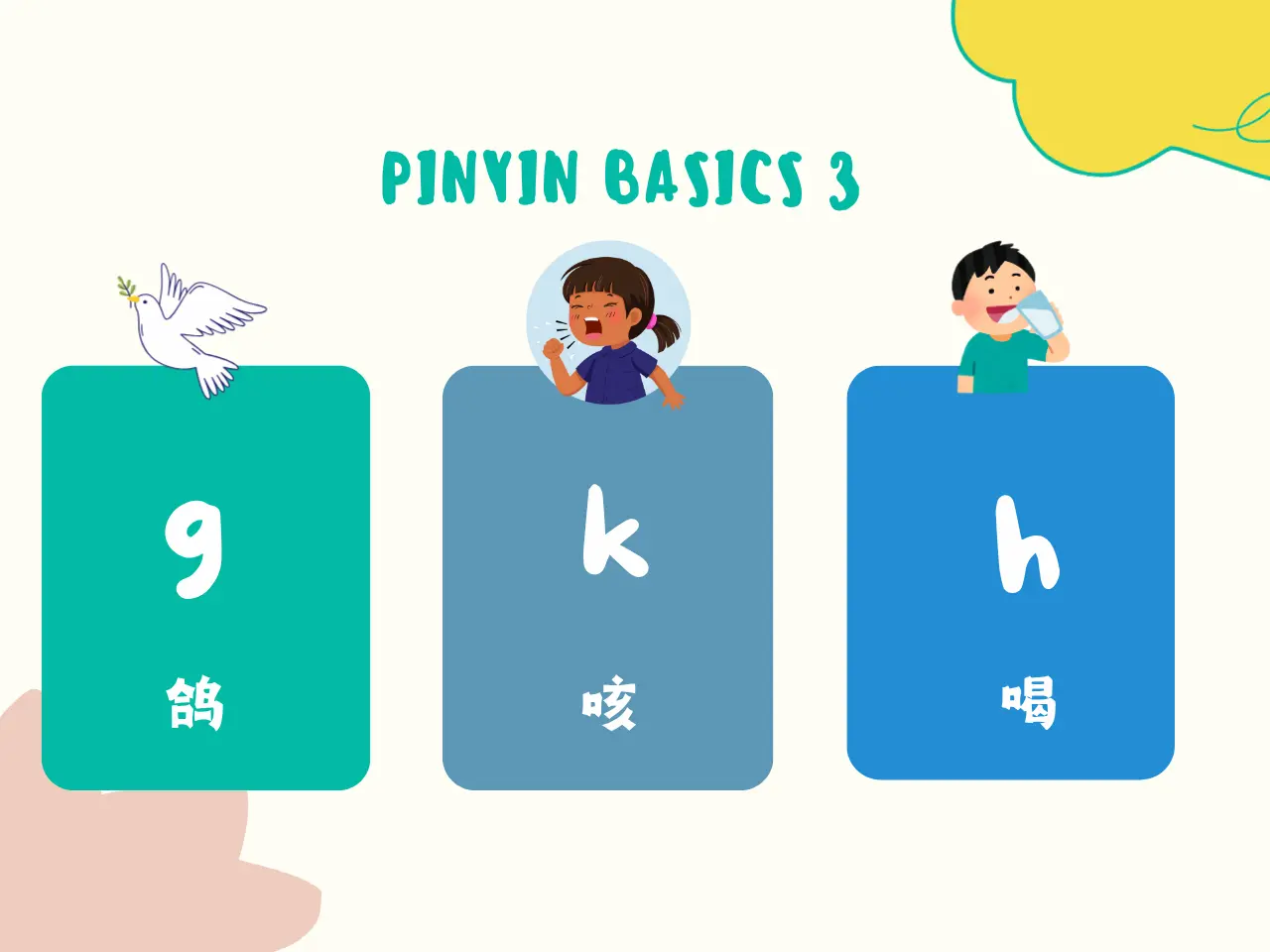
How to Pronounce Each G K H Initial
g — unaspirated, like English "sky"
The pinyin g is unaspirated — closer to the g in "sky" than the g in "go." The back of your tongue blocks the airflow at the soft palate, then releases without a puff of air.
k — aspirated, with a clear puff
The pinyin k is the aspirated partner of g. A noticeable burst of air should leave your mouth, just like the English k in "kite." The g/k contrast works the same way as b/p and d/t.
h — softer than English, with friction
The pinyin h is slightly different from the English h. It is more guttural — closer to the "ch" in Scottish "loch" or the German "Bach," with audible friction at the back of the throat. Soft English "h" is acceptable for beginners, but native-sounding h has more rasp.
G K H Practice Vocabulary
| Chinese | Pinyin | English |
|---|
| 哥哥 | gēge | older brother |
| 高 | gāo | tall / high |
| 看 | kàn | to look / read |
| 咖啡 | kāfēi | coffee |
| 好 | hǎo | good |
| 喝 | hē | to drink |
After G K H: What Comes Next
With BPMF, DTNL, and GKH mastered, you have covered the easiest 11 of the 21 pinyin initials. The harder groups come next: JQX (palatals, where many learners struggle with X), then ZCS (flat sibilants), and finally the retroflex ZH CH SH R.